ASTM A747 Grade CB7Cu-1 H1150 Stainless Steel Properties & Applications
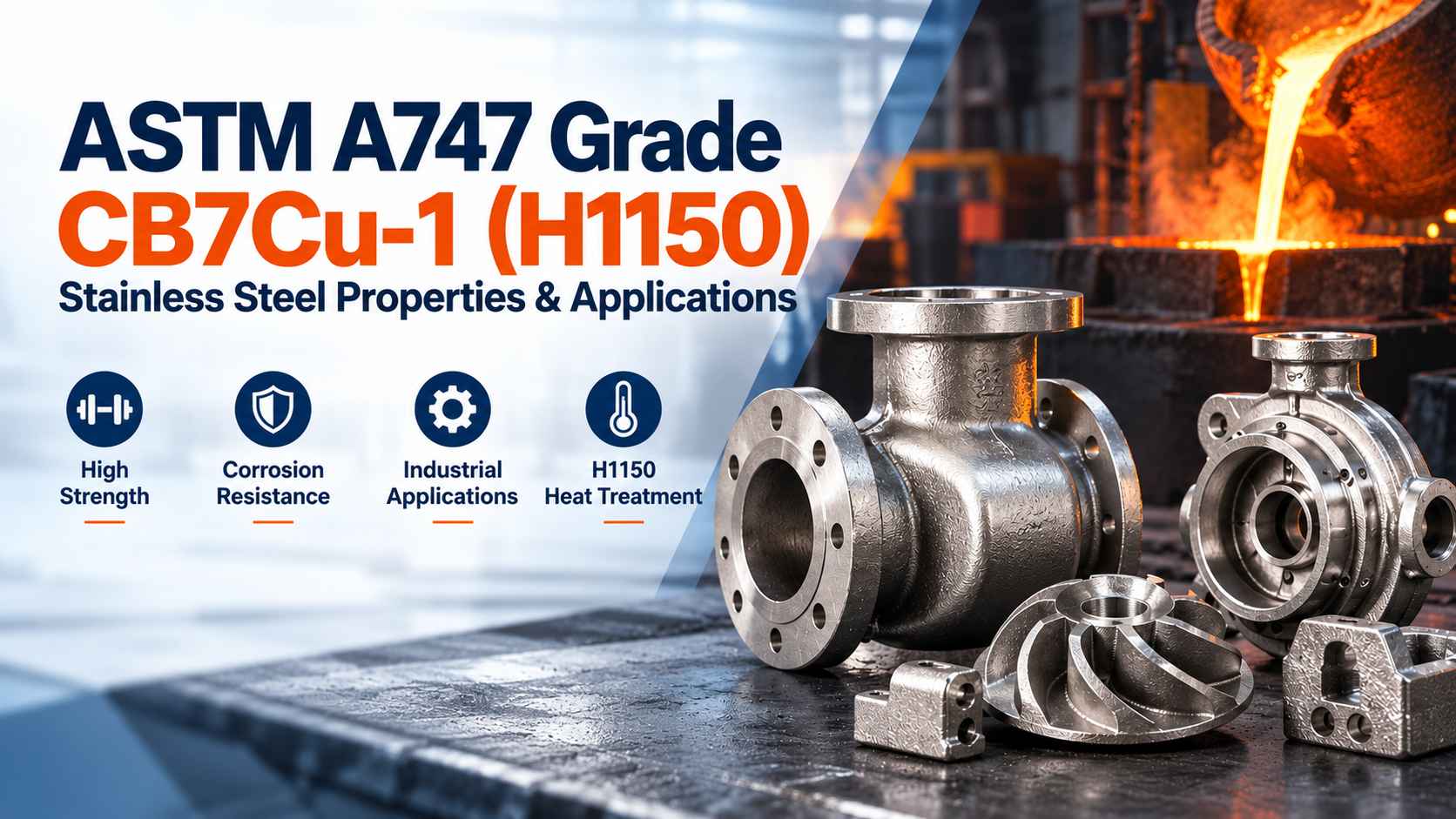
ASTM A747 Grade CB7Cu-1 H1150 Stainless Steel Properties & Applications
26 October, 2026 _ Blog _ BY AMTECH TECHNOCAST PVT. LTD.
Introduction
ASTM A747 Grade CB7Cu-1 (H1150) is a precipitation-hardening stainless steel casting grade used in industrial applications that require a combination of strength, hardness, corrosion resistance, and dimensional reliability. It is associated with the 17-4 PH family of stainless steels and is identified by the UNS designation J92180. The material is covered under ASTM A747/A747M, a specification for precipitation-hardening stainless steel castings.
This grade is suitable for evaluating material options for valve components, pump parts, automotive components, and general engineering applications. Its performance depends on chemical composition, heat treatment, component geometry, and the operating environment.
At Amtech Technocast, material data helps engineers and procurement teams assess whether a particular casting alloy aligns with their component requirements. This guide explains the chemical composition, mechanical properties, heat treatment, applications, and material reference designations of ASTM A747 Grade CB7Cu-1 (H1150).
What Is ASTM A747 Grade CB7Cu-1 (H1150)?
ASTM A747 Grade CB7Cu-1 is a precipitation-hardening stainless steel casting grade containing chromium, nickel, copper, and niobium. Its composition supports the development of strength through controlled heat treatment.
The designation H1150 refers to a specific precipitation-hardening condition. In this condition, the material is aged at a nominal temperature of 1150°F (approximately 621°C) as part of the prescribed heat-treatment process. The complete treatment cycle must follow the applicable material specification and purchase requirements.
Unlike conventional stainless steel grades that rely primarily on solid-solution strengthening or conventional martensitic hardening, precipitation-hardening stainless steels are designed to achieve a controlled balance of mechanical properties through solution treatment and aging.
Key Material Information
Parameter | Details |
Material designation | ASTM A747 Grade CB7Cu-1 (H1150) |
Material category | Precipitation-hardening stainless steel casting |
Standard | ASTM A747/A747M |
UNS designation | J92180 |
Related material family | 17-4 PH |
Material group | Ferrous stainless steel alloys |
Product form | Steel castings |
Primary application areas | Valves, pumps, automotive and general engineering |
Heat-treatment condition | H1150 |
Principal alloying elements | Chromium, nickel, copper and niobium |
Chemical Composition of ASTM A747 Grade CB7Cu-1 (H1150)
Chemical composition plays a significant role in determining the strength, hardness, corrosion resistance and heat-treatment response of stainless steel castings. Each alloying element contributes to the overall characteristics of the material.
The following table reproduces the composition limits published in the Amtech Technocast material datasheet.
Chemical Composition Table
Element | Symbol | Composition (% by weight) |
Carbon | C | 0.070 max. |
Silicon | Si | 1.000 max. |
Manganese | Mn | 0.700 max. |
Phosphorus | P | 0.035 max. |
Sulphur | S | 0.030 max. |
Chromium | Cr | 15.500–17.700 |
Nickel | Ni | 3.600–4.600 |
Copper | Cu | 2.500–3.200 |
Niobium | Nb | 0.150–0.350 |
Nitrogen | N | 0.050 max. |
Iron | Fe | Balance |
Source: Amtech Technocast, ASTM A747 Grade CB7Cu-1 (H1150) material datasheet.
Role of the Main Alloying Elements
Chromium (Cr): Chromium supports the formation of a protective passive surface layer, contributing to stainless steel's corrosion resistance. Its concentration also influences the material's metallurgical structure.
Nickel (Ni): Nickel contributes to the alloy's metallurgical characteristics and helps support the required combination of strength and toughness.
Copper (Cu): Copper is an important alloying element in precipitation-hardening stainless steels. It contributes to age-hardening behaviour and the development of mechanical strength.
Niobium (Nb): Niobium helps control carbon-related metallurgical effects and contributes to the alloy's precipitation-hardening characteristics.
Carbon (C): Carbon affects hardness and metallurgical structure. Its maximum content is controlled to maintain the intended balance of properties.
Silicon (Si) and Manganese (Mn): These elements support steelmaking and deoxidation and influence the material's overall metallurgical behaviour.
Phosphorus (P), Sulphur (S) and Nitrogen (N): Their permitted levels are controlled because they can affect material quality, processing behaviour and mechanical performance.
Iron forms the balance of the composition, with the remaining elements controlled within the applicable specification limits.
Mechanical Properties of ASTM A747 Grade CB7Cu-1 (H1150)
Mechanical properties are essential when selecting a casting material for components exposed to mechanical loads, pressure, or repeated operating cycles.
The Amtech Technocast datasheet specifies the following mechanical properties for CB7Cu-1 in the H1150 condition.
Mechanical Properties Table
Property | Unit | Specified Value |
Minimum tensile strength | MPa | 860 |
Minimum yield strength | MPa | 670 |
Minimum elongation | % | 10 |
Reduction of area | - | - |
Minimum hardness | BHN | 269 |
Impact energy | Joule | - |
Source: Amtech Technocast material datasheet for ASTM A747 Grade CB7Cu-1 (H1150). Values are stated as published in the datasheet.
Understanding the Mechanical Properties
1. Tensile strength: 860 MPa minimum
Tensile strength indicates the maximum tensile stress a material can withstand before fracture during a tensile test. This property is relevant when evaluating the load-bearing capability of a cast component.
2. Yield strength: 670 MPa minimum
Yield strength indicates the stress at which permanent deformation begins under the applicable test method. It is an important consideration for components designed to withstand mechanical loads while maintaining their shape and function.
3. Elongation: 10% minimum
Elongation measures the material's ability to deform plastically before fracture. It provides an indication of ductility and is useful when assessing how the material may respond to mechanical loading.
4. Hardness: 269 BHN minimum
Brinell hardness provides an indication of resistance to localized indentation. It can support material verification and quality-control activities, but it does not independently establish wear resistance or overall service life.
The values above should be checked against the governing specification, the specified heat-treatment condition and the applicable test requirements before they are used for engineering design or contractual acceptance.
Applications of ASTM A747 Grade CB7Cu-1 (H1150)
The Amtech Technocast datasheet identifies valves, pumps, general engineering, automotive and other industrial sectors as application areas for this material.
1. Valve Components
Stainless steel castings may be considered for valve bodies and other valve components where mechanical strength and corrosion resistance are important. Final suitability depends on the pressure rating, fluid chemistry, temperature and relevant industry requirements.
2. Pump Components
Pump components may operate under mechanical loads and exposure to liquids. CB7Cu-1 can be evaluated where its strength and stainless steel characteristics align with the operating environment and design specifications.
3. General Engineering
Industrial machinery and engineering equipment can require cast components with complex geometries and controlled mechanical properties. Precipitation-hardening stainless steel may be suitable for selected applications following technical evaluation.
4. Automotive Applications
Selected automotive components may require a combination of strength, dimensional accuracy, and material consistency. The use of CB7Cu-1 should be determined by the component's design, service environment, and applicable qualification requirements.
5. Other Industrial Applications
Other applications may be considered when the material's chemical composition, heat-treatment condition, and verified mechanical properties meet the engineering requirements.
Important: These are application areas identified or supported by the material's general classification, not a guarantee that the grade is suitable for every component in those industries.
Cross-Reference Designations for ASTM A747 Grade CB7Cu-1
Material cross-reference tables help engineers and purchasing teams identify related designations across different material standards. However, similar or commonly associated designations should not automatically be treated as technically interchangeable.
The Amtech Technocast datasheet lists the following cross-reference information.
Material Cross-Reference Table
Material Designation | Standard or Reference | Country / Region | Industry or Material Category |
J92180 | UNS | USA | Casting |
SA-747 CB7Cu-1 | ASME | USA | Casting |
17-4PH | SAE | USA | Steel |
Z 7 CNU 17-04 | AFNOR NF | France | Steel |
5622 | AMS | USA | Bar, wire, tube and forging |
X 5 CrNiCuNb 16-4 | DIN | Germany | Steel |
X 5 CrNiCuNb 16-4 | EN | European Union | Forging |
Source: Amtech Technocast material datasheet.
These entries reproduce the source datasheet's cross-reference table. Before substituting one designation for another, confirm the applicable standard edition, product form, chemical requirements, heat-treatment condition and mechanical-property acceptance criteria. A related wrought-steel grade, for example, may not have identical requirements to a cast-steel grade.
ASTM A747 Grade CB7Cu-1 (H1150) Material Datasheet
For convenient technical reference, the complete material datasheet is available from Amtech Technocast.
Material: ASTM A747 Grade CB7Cu-1 (H1150)
Document: Chemical composition, mechanical properties, heat-treatment information and material cross-reference designations.
View the original datasheet: ASTM A747 Grade CB7Cu-1 (H1150) PDF
For material qualification or a project-specific requirement, consult the full governing specification rather than relying solely on a summary datasheet.
Conclusion
ASTM A747 Grade CB7Cu-1 (H1150) is a precipitation-hardening stainless steel casting grade used for evaluating industrial components that require defined strength, hardness and material composition. Its specified minimum tensile strength of 860 MPa, minimum yield strength of 670 MPa, and minimum elongation of 10% provide useful reference points for engineering assessment.
For reliable material selection, chemical composition and mechanical properties should always be considered alongside heat treatment, casting quality, inspection requirements and service conditions. The original Amtech Technocast datasheet provides a convenient starting point for evaluating this material, while the full applicable standard and project requirements remain the basis for technical approval.
FAQs
1. What is ASTM A747 Grade CB7Cu-1 H1150?
ASTM A747 Grade CB7Cu-1 H1150 is a precipitation-hardening stainless steel casting grade known for its strength and corrosion resistance.
2. What does H1150 mean in ASTM A747 Grade CB7Cu-1?
H1150 refers to a precipitation-hardening heat-treatment condition involving aging at approximately 1150°F (621°C).
3. What is the chemical composition of CB7Cu-1 stainless steel?
Its main alloying elements are chromium, nickel, copper, and niobium.
4. What are the applications of ASTM A747 Grade CB7Cu-1 H1150?
It is used in selected valve components, pump parts, automotive components, and industrial castings.
5. What are the mechanical properties of CB7Cu-1 H1150?
It has a minimum tensile strength of 860 MPa, yield strength of 670 MPa, and elongation of 10%, according to the referenced datasheet.
Let’s Get in Touch
Your email address will not be published. Required fields are marked
